
Action Alert: Should AI be Used to Improve Local Advocacy?
A Sample System Explained
All my readers know that I have warned about the potential for AI to be massively transformative and disruptive to the job market, the informational landscape we inhabit daily and even coming governance structures.
There are real dangers of losing cognitive abilities—and many other things—as this technology is hastily being deployed throughout the culture, institutions and governance platforms. I have struggled whether to integrate the possible benefits into my own workflows as the battle against time and the relentless advance of the enemy to transform our society proceed unabated.
Smartsheepe is a reader-supported publication. To receive new posts and support my work, consider becoming a free or paid subscriber.
And so, I submit to you the following case study.
A local advocacy group has been faithfully monitoring local government (Pima County Board of Supervisors) in the Tucson area scouring the upcoming meeting agenda and distributing a watch-sheet of sorts to a mailing list. Citizens are encouraged to reach out to their supervisors about action items of concern via email.
It’s an incredibly valuable service however, it suffers from the following…
Newsletter could be more user friendly, striping legal jargon etc.
No way to determine the level of participation (citizens taking action)
No follow up on the results
No sharing of wins
Here is the redesigned workflow with some help from AI.
User friendly Summary below which could be printed out and distributed at churches, doctors offices.
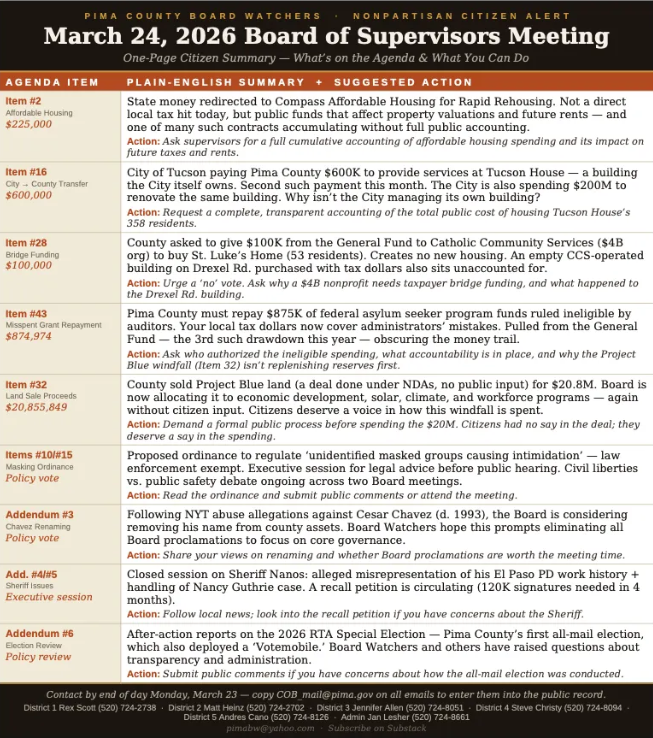
A User-Friendly Summary Output created by Claude AI
One change on the bottom would be to add a request that activists bcc an alias proton email in order to track the level of advocacy.
Finally, we need to complete the feedback loop by taking the transcript of the actual meeting (available on youtube) and asking AI to create a summary document that closes the loop on whether the advocacy had any effect or not.
The Summary Version can be found here. Now we have a complete feedback loop.
A Citizen-friendly call-to-action that can be printed and distributed as well as viewed online
The number of citizens that took action (bcc)
The results of the board (Win, Lose, draw)
Ultimately, a determination could be made as to the effectiveness of the advocacy. How many people actually took action? Did the advocacy have an effect? Would highlighting wins increase advocacy?
With the use of AI, could these praiseworthy efforts be made more effective?
Alternatively, it might be revealed that most efforts go unheeded by the Board.
Note: The original effort to define the upcoming board issues still requires human labor and intelligence!
What say you Smart sheepers…
Stay alert for the next post in this 3 part series…
SHOULD AI BE USED FOR SOMETHING LIKE THIS OR NOT?
Reply to this email or post comments?